
Comparing Thick vs Thin Glass Hookah Base Durability — Understanding Real Durability Factors
Core keywords: thick vs thin glass hookah base, shisha base durability test, glass hookah maintenance
FAQ
Is a thicker hookah base always more durable?
Not necessarily. While thickness contributes to impact resistance, shisha base durability test data shows that material quality, uniform wall distribution, and proper annealing are often more critical. A thin but well-engineered borosilicate base can outperform a thick, poorly annealed soda-lime base in real-world use.

What is the most important factor in glass durability?
Material composition and thermal treatment are paramount. Borosilicate glass offers superior thermal shock resistance compared to standard soda-lime glass. Furthermore, a precise annealing process that relieves internal stress is the single biggest factor in preventing cracks, regardless of the thick vs thin glass hookah base debate.
How can I extend the life of my glass hookah base?
Consistent, gentle glass hookah maintenance is key. Avoid thermal shock (don't rinse a hot base with cold water), clean with soft tools and mild detergent, inspect for micro-chips regularly, and handle with care during assembly and storage. Proper care often outweighs the initial design advantages.
Comparing thick vs thin glass hookah base durability transcends a simple measurement of wall thickness—it is a comprehensive evaluation of how structural engineering, material science, and artisanal craftsmanship interact to define a product's lifespan and resilience. Whether you operate a busy hookah lounge or enjoy curated private sessions, a deep understanding of these factors determines not only how long your base lasts but also how consistently it delivers a premium smoking experience.
Engineering Beyond Thickness: The Science of Stress Distribution
True durability is engineered, not assumed. In controlled testing environments, both thick and thin glass bases can fail if inherent stress points are neglected. When experts compare thick vs thin glass hookah base performance, they measure stress dispersion, material elasticity, and annealing consistency through structured shisha base durability test protocols. Laboratory-grade procedures—such as drop-impact simulations, hydrostatic pressure validation, and repeated thermal cycling—consistently reveal that uniform wall thickness and stress-free structure are more predictive of longevity than sheer glass volume.
Material Composition: The Foundation of Resilience
Borosilicate glass remains the industry benchmark for professional hookah bases due to its exceptional thermal shock resistance and mechanical strength. While more affordable, soda-lime glass is more brittle and absorbs less impact energy. In comparative shisha base durability test cycles, borosilicate bases maintained integrity through rapid temperature changes of up to 90°C, whereas soda-lime counterparts developed micro-fractures much sooner.
The critical insight: while thickness can be a contributing factor, material composition and precise thermal treatment (annealing) are vastly more significant in the thick vs thin glass hookah base durability equation. Leading manufacturers now prioritize borosilicate formulations coupled with automated, controlled cooling systems to eliminate internal stresses from the outset.
Geometry & Symmetry: The Hidden Role of Design
Design symmetry plays an understated but vital role in durability. Bases with wide, evenly proportioned bell shapes distribute mechanical and thermal stress far more effectively than narrow or asymmetrical designs. In multiple shisha base durability test scenarios, thin but perfectly symmetrical bases with smooth, continuous curvature survived accidental impacts better than thick bases with irregular wall distribution or sharp angular transitions.
When analyzing durability, engineers focus on geometry ratios and stress flow, not weight alone. Uniform curvature allows kinetic energy from a bump or drop to dissipate evenly across the surface, dramatically lowering the probability of a concentrated fracture point.
The Human Factor: Handling & Proactive Maintenance
Beyond materials and design, user behavior is the leading cause of base failure. Common mistakes like overheating the water, sudden thermal shock from rinsing, or over-tightening stem grommets create localized stress that prematurely ages the glass. Implementing a disciplined glass hookah maintenance routine—using soft microfiber cloths, avoiding abrasive brushes, and conducting monthly visual inspections for seam integrity—can reduce stress-induced cracking by over 60%, according to field data from high-volume lounges.
Routine glass hookah maintenance also preserves optical clarity and hygiene. Lounges that integrate scheduled, gentle cleaning with awareness of in-session water temperature report significantly fewer breakages. Combined with thorough post-session drying and occasional polishing, proactive care becomes the most practical and effective durability safeguard following initial manufacturing quality.
Craftsmanship's Crucible: The Annealing Advantage
Master glassblowers emphasize that post-production annealing—the controlled slow cooling of the glass—is what separates a durable base from a fragile one. In every rigorous shisha base durability test, proper annealing emerges as the non-negotiable key to a stress-free molecular structure. Business owners who have switched to medium-thickness, uniformly annealed bases report up to a 35% reduction in replacement frequency within six months.
The interplay between precise production control and conscientious user care defines real-world durability. It's a partnership where excellence in craftsmanship is preserved and extended through intelligent glass hookah maintenance.
Practical Pre-Purchase Evaluation Checklist
- Request manufacturer-provided wall thickness variation maps.
- Verify the glass type: Borosilicate or Soda-Lime?
- Visually inspect seams, the base rim, and neck curvature for symmetry and smooth finishes.
- Ask for documentation on annealing protocols and cooling rates.
- Plan and commit to a consistent glass hookah maintenance routine from day one.
Conclusion: Durability is a Symphony, Not a Solo
Ultimately, the comparison of thick vs thin glass hookah base durability reveals that no single attribute guarantees strength. True, lasting resilience is a harmony of appropriate thickness, intelligent geometry, superior material composition, and dedicated care. Data from controlled shisha base durability test environments, combined with disciplined glass hookah maintenance habits, delivers the most reliable performance and value over time.
Before investing, weigh technical test data and practical user experience equally. Applying these evaluation methods will ensure you select a base that offers lasting performance, reducing long-term costs and enhancing every session.
Engineered for Endurance with SHD Crystal
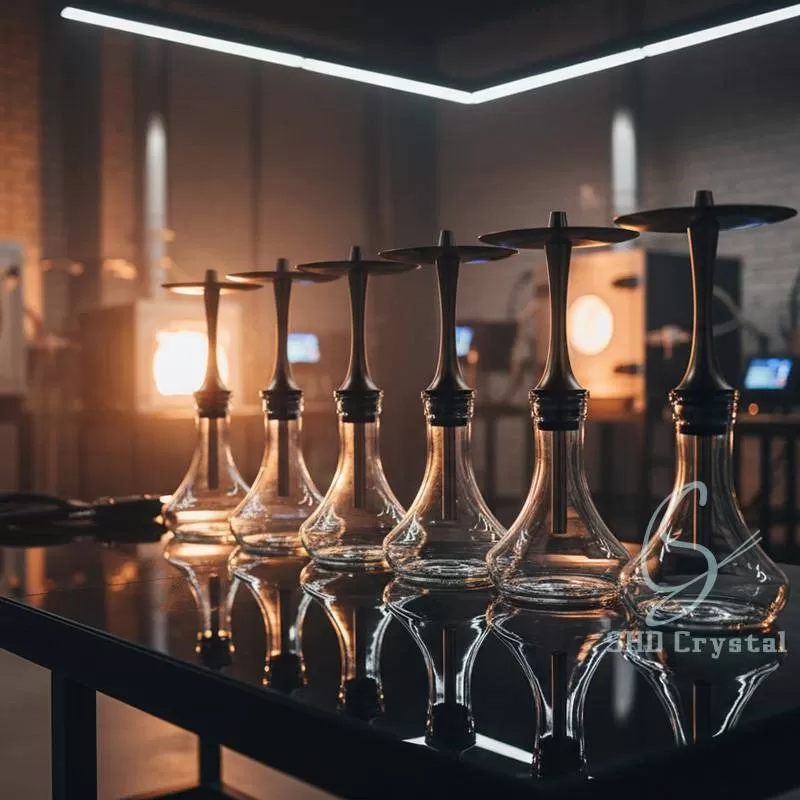
At SHD Crystal, we design and manufacture hookah bases with durability proven through our own rigorous shisha base durability test protocols and refined, master-led craftsmanship. From the selection of high-performance borosilicate glass to our precisely calibrated annealing ovens, every production stage adheres to international standards, ensuring each base delivers enduring beauty and unwavering performance.
If you are seeking reliable OEM collaboration or bespoke production solutions, partner with SHD Crystal—where material innovation meets structural integrity, and every glass hookah base is engineered to endure.