

Production Standards for Hookah: How Global Regulations Shape Quality and Export
Core keywords: production standards for hookah, hookah manufacturing quality, international shisha regulations
FAQ
What are the most important production standards for hookah manufacturers?
Key production standards for hookah focus on material safety (lead-free, food-grade materials), structural integrity (airtight seals, pressure resistance), and hygienic design. Compliance with certifications like ISO 9001, CE marking, and regional safety directives is essential for hookah manufacturing quality and market access.

How do international regulations differ by region?
International shisha regulations vary significantly. The EU enforces strict CE and REACH compliance for consumer safety and material restrictions. North America focuses on CPSIA and ASTM standards. Middle Eastern markets often have their own national standards (like SASO). Manufacturers must tailor their compliance strategy to each target market's specific legal framework.
Why is certification critical for global export?
Certification provides verifiable proof that a product meets the safety and quality requirements of the importing country. It streamlines customs clearance, builds distributor and retailer trust, and protects brands from liability, rejection, or recalls. In essence, it transforms documented quality into a tangible competitive advantage in global trade.
In the rapidly evolving global shisha market, production standards for hookah have transcended their role as mere technical guidelines—they are now the fundamental bedrock of product integrity, enduring brand trust, and international competitiveness. As demand for premium hookahs surges worldwide, leading manufacturers from traditional hubs like Egypt and Turkey to industrial powerhouses like Germany and China are systematically aligning their processes with stringent international shisha regulations. This alignment is not optional; it is the critical pathway to ensuring consistent quality, user safety, and reliable performance on a global scale.
The Framework of Modern Hookah Manufacturing Quality
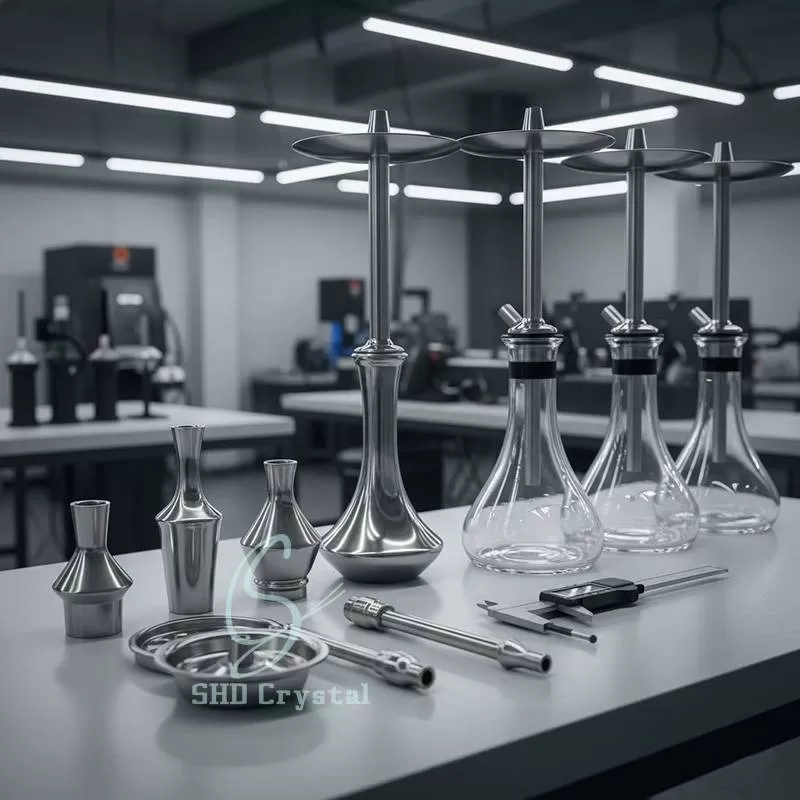
At their essence, comprehensive production standards for hookah establish the definitive rules governing the creation, assembly, and final validation of every waterpipe component. They set clear, measurable parameters for:
- Material Safety: Mandating the use of non-toxic, heat-resistant materials such as medical-grade stainless steel, food-safe aluminum alloys, lead-free glass, and platinum-cure silicone. All surface coatings and paints must be inert and certified for consumer contact.
- Design & Mechanical Safety: Ensuring components connect with precision to prevent air or water leaks, while internal airways are engineered to maintain optimal pressure balance for a consistently smooth hookah draw.
- Durability & Performance Testing: Subjecting finished products to rigorous simulations of long-term use, including corrosion resistance tests, thermal shock cycles, and stress tests from repeated cleaning.
In traditional centers of excellence like Egypt and Turkey, deep-rooted craftsmanship remains paramount. Artisans follow time-honored techniques but now integrate standardized quality checkpoints for leak-proof seals and thermal resilience. Conversely, China's advanced manufacturing sector emphasizes precision engineering at scale, where hookah manufacturing quality is assured through integrated ISO 9001 systems, third-party SGS validation, and automated calibration processes. Meanwhile, Germany’s regulatory landscape prioritizes environmental stewardship, precision welding, and full CE compliance to satisfy the EU's comprehensive consumer safety directives.
Enforcement & Compliance: Navigating International Shisha Regulations
Adherence to international shisha regulations is validated through a combination of third-party audits and accredited laboratory testing. Prior to export, manufacturers are required to supply comprehensive documentation proving their products meet the specific safety and durability laws of the destination country.
Independent testing agencies typically evaluate:
- Air-tightness integrity and stable airflow metrics.
- Heat and pressure resistance of critical components like the bowl and stem.
- Material purity, with screening for restricted heavy metals (e.g., lead, cadmium, phthalates).
- The thermal shock resistance and overall durability of glass bases.
For exporters, certification and full-chain traceability have become indispensable elements of the logistics process. Many countries now mandate technical data sheets, Certificates of Conformity (CoC), and pre-shipment inspection reports for customs clearance. Increasingly, even packaging and labeling—including explicit country of origin, care instructions, and complete material disclosures—must conform to international guidelines.
The Impact on Global Trade and Brand Equity
Maintaining robust production standards for hookah directly influences a product's journey through complex international supply chains. Brands that consistently meet or exceed recognized standards do more than minimize the risk of shipment rejections—they secure a stronger, more reputable position in premium markets.
Retailers and distributors now routinely demand verified hookah manufacturing quality documentation as a prerequisite for partnership. A hookah bearing CE, ISO, or other recognized marks signals proven reliability, building indispensable trust with both B2B partners and end-consumers. In discerning markets like Europe and North America, this credibility can decisively position a brand as a professional, artisanal leader versus an unverified import.
From the consumer perspective, adherence to strict standards translates directly into safer, more durable, and better-performing products. Modern buyers are increasingly conscious of the materials in their smoke path, leading to greater scrutiny of non-compliant products. Therefore, superior production standards are no longer just about compliance—they are a powerful source of competitive differentiation and brand loyalty.
Future Challenges and Evolving Trends
As global sustainability imperatives intensify, manufacturers must also adapt to eco-friendly production protocols. Many regions are phasing out hazardous plating chemicals and mandating the use of recyclable or biodegradable materials. Furthermore, digital traceability—such as QR codes linked to batch-specific certification and material origin—is emerging as a new expectation for high-value exports, enhancing transparency.
This evolution signals that future production standards for hookah will expand beyond core safety to encompass environmental responsibility, supply chain transparency, and enhanced user experience. The hookah industry, long guided by tradition, is decisively entering an era defined by technical excellence, ethical manufacturing, and accountable innovation.
Conclusion: Quality as the Definitive Brand Identity
In today's interconnected marketplace, a hookah brand's success is inextricably linked to its commitment to compliance, precision, and accountability. Robust production standards for hookah guarantee that every product not only captivates aesthetically but also fulfills the stringent expectations of global regulators and discerning enthusiasts alike.
As consumer awareness and international oversight continue to rise, manufacturers who prioritize uncompromising hookah manufacturing quality and proactively adhere to international shisha regulations will distinguish themselves as the trusted leaders and craftsmen of the global shisha community.
SHD Crystal: Where Integrity Meets Artistry
At SHD Crystal, we operate on a foundational belief: true artistry begins with unwavering integrity. Our mission is to elevate the global hookah experience through transparent material sourcing, rigorously certified production processes, and consistently superior quality—actively setting new benchmarks for what modern, responsible shisha manufacturing can and should be.